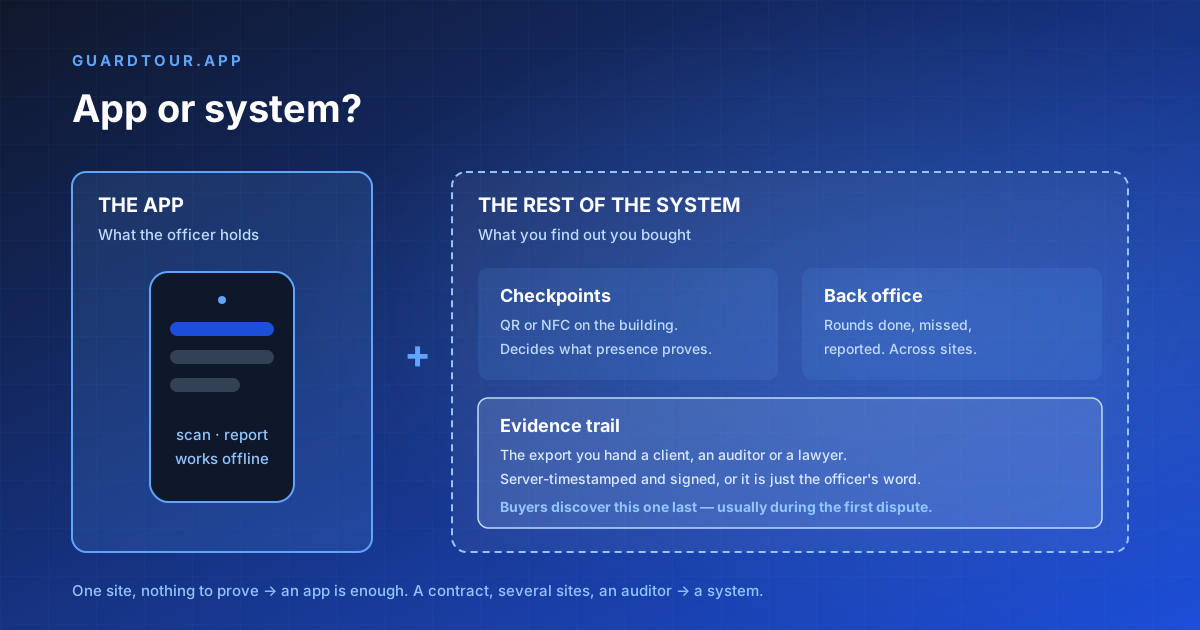
A guard tour app is the piece the officer holds: a phone application that scans checkpoints and records what happened on a round. A guard tour system is that app plus the parts nobody sees on shift — the physical checkpoints, the back office where supervisors read the results, the export that survives a client dispute, and the rules that decide what counts as a completed patrol.
Most vendors sell you a system and call it an app, because "app" is what people search for. That is fine until the day you need something the app alone cannot do, and the difference stops being vocabulary.
The four parts of a system
1. The app on the officer's phone. Scans QR or NFC checkpoints, captures incidents with photo and time, works with no signal and syncs later. This is the part everyone evaluates, and it is the part that matters least when things go wrong — because nearly every product on the market does it adequately.
2. The checkpoints. QR labels or NFC tags fixed to the building. Cheap, but they decide what your evidence is worth: a QR sticker that can be photographed and scanned from the car park proves nothing about presence. NFC has to be physically touched. This choice is not a feature comparison, it is a decision about what kind of fraud you need to rule out.
3. The back office. Where a supervisor sees which rounds happened, which were missed and what was reported. If your operation runs one site with one officer, you can live without it. At three sites it becomes the reason you bought the product.
4. The evidence trail. The export you hand to a client, an auditor or a lawyer. This is the part that separates an app from a system, and the part buyers discover last — usually during the first dispute.
Which one your situation actually calls for
You need an app, and only an app, if: one site, one or two officers, the patrol record is for your own peace of mind, and no client contract obliges you to prove anything. A free plan covers this completely and you should not pay for more.
You need the system if any of these is true:
- A client contract specifies patrol frequency. The moment "four rounds per night" is written into a contract, you need something that shows four rounds happened, on the nights they were billed. That is a back office and an export, not an app.
- You bill by service, and a client disputes it. An app on the officer's phone is the officer's word in digital form. A server-timestamped record is a different kind of document.
- More than one site. Supervisors stop being able to hold the state of the operation in their head somewhere around the third site.
- Anyone audits you. Insurer, client, regulator, certification body. They do not read phone screens; they read exports.
- Shift handovers matter. Two officers, two devices, one continuous record — that is a system-level concern, not an app feature.
The question to ask a vendor
Not "does the app work offline" — everyone says yes. Ask instead: "show me the export you would give my client after a disputed night, and tell me what stops someone editing it."
The answer separates the market fast. What you want to hear is that the record is timestamped and signed server-side, that the file is exported in a fixed format, and that a scan made outside the checkpoint's location is flagged rather than silently accepted. If the answer is "you can export a PDF", you have an app.
Where the words come from
The naming is historical. "Guard tour system" is the older term and comes from the physical era: a mechanical clock the officer carried, with keys chained at each station. The system was the clock, the keys and the paper disc. When those moved to phones, "app" replaced "system" in how people searched — but the parts of the old system did not disappear, they just stopped being visible.
That is why a vendor can honestly answer "yes, we have an app" and still be missing three quarters of what you are buying.
What this looks like here
PatrolTech ships the whole system and prices only one part of it: checkpoints. Officers are unlimited on every plan, including the free one, because charging per officer punishes you for the thing you cannot control — turnover in a high-churn industry.
The free plan is 5 checkpoints, one site, two dashboard users and 30 days of history — genuinely enough for the single-site case above, permanently, with no card. Paid plans start at $29 / 29 € per month for 10 checkpoints. The full breakdown, including the point where the plans meet, is on the pricing page.
When this is not the right product: if you need man-down detection or facial verification of the officer generally available today, ours are in beta on the Business plan only. If you need Bluetooth beacons rather than QR or NFC, beacons are on the roadmap; we chose digitally signed NFC tags instead. Those are real reasons to buy elsewhere, and you will find out faster here than in a demo.
Short version
- The app is what the officer holds. The system is the app, the checkpoints, the back office and the evidence trail.
- One site and no contractual obligation to prove anything → an app is enough, and it should be free.
- A contract, a client who might dispute an invoice, several sites, or anyone who audits you → you are buying a system, whatever the pricing page calls it.
- The question that tells them apart: what does the export look like, and what stops someone editing it.