A regional security contractor in the Pacific Northwest signed a 3-year deal with a major guard tour vendor in 2022 at a "discounted" per-site rate of $89/site/month for 14 sites — total $1 246/month, looked attractive. By month 18, the operation had grown to 32 sites following a hospital network expansion, and the per-site fee was now $2 848/month. Worse, the contract included an "officer cap" clause buried in section 7.3: each site was limited to 6 active officers per month before "expansion fees" kicked in at $12/officer over the cap. By month 24, the company was paying $4 100/month for the same software that the contractor's competitor was selling for $1 500/month on a clean per-officer-only model. The contractor exited the contract at month 36 paying a $9 800 early termination fee.
The mistake wasn't the vendor — it was choosing the wrong billing dimension for the operation's growth pattern. Some operations are officer-stable (the headcount barely changes month to month, but they keep adding sites). Others are site-stable (the same 10 sites for years, but the officer roster turns over). The pricing model that fits one breaks for the other. This post explains the three real billing models, walks through a 5-year TCO for a 50-officer / 10-site operation under each, and lists the hidden costs that flip the math by 20-40%.
The three real billing models
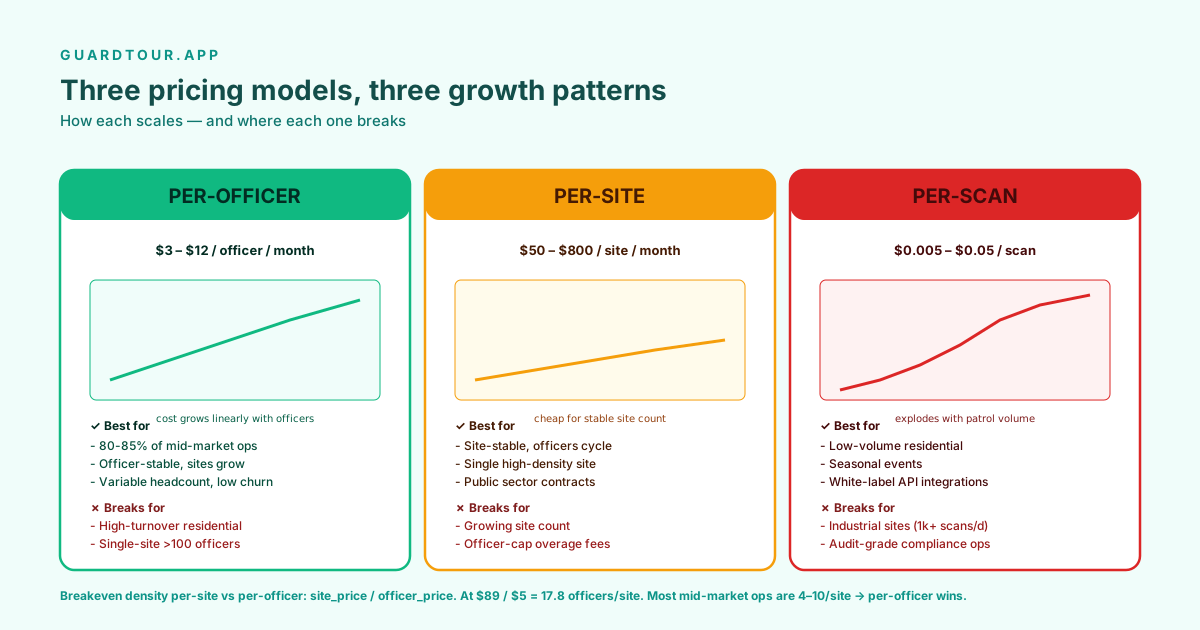
Model 1 — Per-officer monthly billing. You pay a fixed monthly fee per active officer in the system. An officer that did 14 shifts last month costs the same as one that did 22. New officers added mid-month are pro-rated. Inactive officers (no logins for X days) are typically auto-removed from billing. Industry standard pricing: $3-12 USD per officer per month. The dominant model in TrackTik, GuardsPro and most legacy vendors — though guardtour.app and PatrolTech have since moved to per-checkpoint pricing (see below).
Model 2 — Per-site monthly billing. You pay a fixed monthly fee per site (location, building, contract). Unlimited officers within each site, sometimes capped (the contract example above). Industry pricing: $50-200 USD per site per month for SMB tier, $300-800 for enterprise. Common in legacy vendors (some Honeywell legacy deals) and a few large security integrators.
Model 3 — Per-scan or per-event billing. You pay per checkpoint scan or per "patrol event" delivered. Cheap for low-volume operations (residential patrols with 50 scans/day) but explodes for industrial sites with 1 000+ scans/day. Industry pricing: $0.005-0.05 per scan. Common in white-label / API-only providers and some integrations with larger PSIM platforms.
A fourth quasi-model exists, the all-you-can-eat enterprise flat fee ($X 000/year unlimited), but it's only available for >500-officer operations and almost always comes with consulting/implementation fees that bring effective per-officer cost back into the $4-8 range.
5-year TCO for a 50-officer / 10-site operation
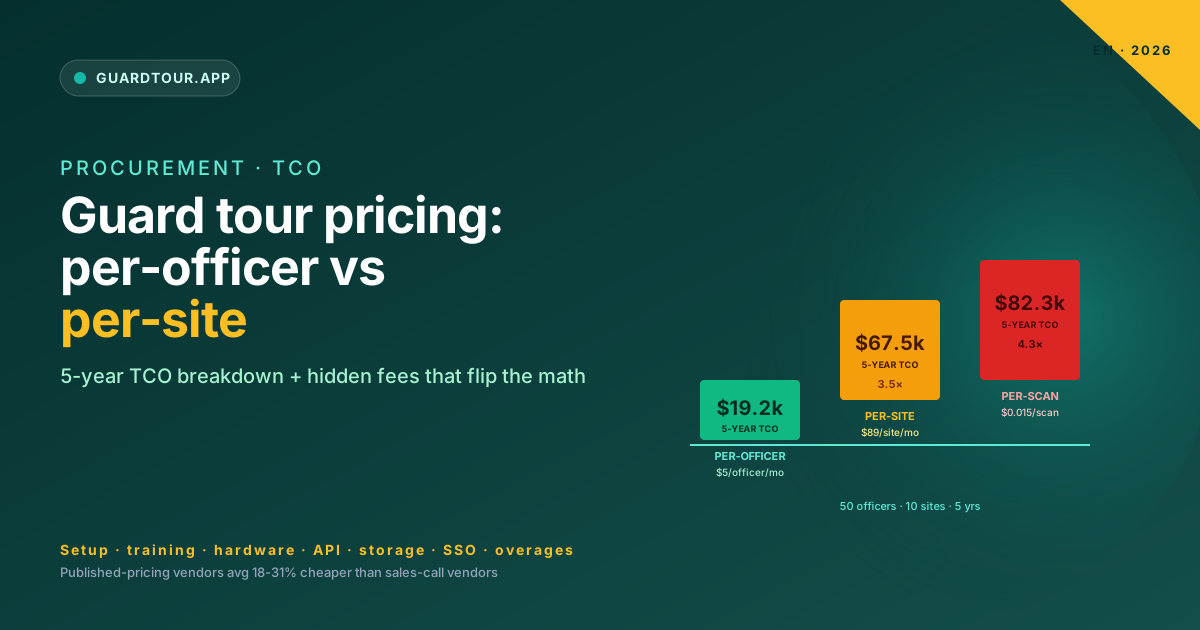
A reference operation: 50 active officers, 10 sites (mix of commercial buildings + a healthcare facility), 4-year retention of officers (industry average), 8% annual growth in sites and 12% annual growth in officers. The TCO calculation includes software licensing, setup fees, training, hardware (if proprietary required), and the hidden costs broken out separately.
Model 1 — Per-officer at $5/officer/month:
- Year 1: 50 officers × $5 × 12 = $3 000. Setup fee: $0 (modern vendors waive). Training: $0 (self-serve).
- Year 2: ~56 officers × $5 × 12 = $3 360.
- Year 3: ~63 × $5 × 12 = $3 780.
- Year 4: ~71 × $5 × 12 = $4 260.
- Year 5: ~80 × $5 × 12 = $4 800.
- 5-year TCO: $19 200.
Model 2 — Per-site at $89/site/month:
- Year 1: 10 sites × $89 × 12 = $10 680. Setup fee: $1 500. Training: $800.
- Year 2: ~11 × $89 × 12 = $11 748.
- Year 3: ~12 × $89 × 12 = $12 816.
- Year 4: ~13 × $89 × 12 = $13 884.
- Year 5: ~14 × $89 × 12 = $14 952.
- Officer cap overage (year 3 onwards, ~3 sites exceed 6-officer cap): ~$3 200 total.
- 5-year TCO: $67 580.
Model 3 — Per-scan at $0.015/scan with avg 200 scans/site/day:
- Year 1: 10 sites × 200 scans × 365 days × $0.015 = $10 950.
- Year 2: 11 sites × 220 (growth) × 365 × $0.015 = $13 244.
- Year 3-5 scaling proportionally: $15 600 + $18 300 + $21 400.
- Hardware (proprietary tags required by this vendor): $2 800.
- 5-year TCO: $82 294.
The per-officer model is 3.5x to 4.3x cheaper over 5 years for this operation. The break-even where per-site becomes competitive is when officer density per site exceeds 12, which is unusual outside of casinos, hospitals or very large industrial sites.
When per-officer is wrong
There are operations where per-officer pricing is actually worse:
High-turnover residential operations. A residential security company that hires + fires officers monthly (industry turnover rate sometimes 80%/year) ends up paying for officers who never finish a single shift. Per-site or per-scan removes this overhead.
Single-site high-density operations. A casino with 200 officers on one site at any given moment is sometimes cheaper on per-site even at $800/month than on per-officer at 200×$5 = $1 000/month.
Highly seasonal operations. Music festival security or holiday retail patrols with 6-week intense periods don't fit per-officer monthly. Per-event or short-term per-officer with daily billing is better.
Government contracts with fixed budgets. Some public sector contracts can only invoice "per site" line items due to procurement category limitations. Per-officer is technically cheaper but bureaucratically impossible.
For 80-85% of mid-market security operations (50-500 officers, 5-50 sites, mixed verticals), per-officer is the optimal choice. The exceptions are real but specific.
The hidden costs that flip the TCO
The list price is rarely the actual cost. Hidden costs to verify before signing:
Setup and implementation fees. Some vendors charge $1 500-5 000 just to provision the account. Modern vendors waive this; legacy vendors hide it in "professional services". Always verify in writing.
Training costs. Some vendors charge per-seat training ($150-300/officer for "certification"). The defensible cost is zero — modern apps are self-service and require no certification. Charge for training is a red flag.
Proprietary hardware lock-in. Vendors that require their own NFC tags ($8-15/tag) lock you into their hardware. A 200-checkpoint deployment costs $1 600-3 000 just in tags. Modern vendors support standard NTAG 215/216 tags from any source (under $0.50/tag in bulk).
API and integration fees. Many vendors gate API access behind enterprise tier or charge $200-500/month for API access. A reasonable vendor includes read-only API in all tiers and webhooks in the standard tier.
Annual minimum guarantees. Per-officer contracts sometimes have annual minimum officer counts. A contract with "minimum 50 officers/month" billed at $5 means you pay $3 000/year even if you only have 30 officers active. Common in long-term enterprise contracts.
Scan caps and overages. Even on per-officer contracts, some vendors cap scans per officer (e.g., "max 200 scans/officer/month, additional at $0.10 each"). This can balloon for industrial operations with high checkpoint density.
Storage and retention overages. Photos and videos consume storage. Some vendors charge for retention beyond 90 days ($X/GB/month). Audit-grade retention (5 years for GMP, 7 years for HIPAA-adjacent) under those terms gets expensive.
SSO and SAML fees. Charging extra for SSO is a red flag — it should be standard at any non-trivial tier. Vendors that charge $200+/month for SSO are pricing on the desperation of compliance-bound buyers.
Mobile app upgrade fees. Some legacy vendors charge for major Android/iOS version upgrades. The modern standard is included.
Geographic deployment fees. Multi-region (EU + US) deployments sometimes incur separate licensing. Verify whether the global price is unified or geographic.
Public vs sales-call vendors
A practical observation from procurement reviews 2024-2025: vendors that publish full pricing online average 18-31% cheaper effective cost than vendors that require a sales call. This isn't because the published vendors are inherently cheaper — it's because the negotiation overhead, the implementation fees and the "custom" packaging add 15-30% to the effective cost of sales-call vendors. The published price is the floor; the sales-call price is whatever the rep thinks you'll pay.
For a 50-officer operation, the procurement effort cost itself (RFI + RFP + 3-4 sales calls + legal review) is typically $4 000-8 000 in internal time. If you can avoid that on a $20 000 software decision, the published-pricing vendor wins on TCO before the first dollar of software fees.
How to choose: a 3-step decision
Step 1 — Plot your growth pattern. Are you officer-stable (sites grow faster than officers) or site-stable (officers cycle but sites are constant)? Officer-stable with growth → per-officer. Site-stable with low churn → per-site might work. Variable seasonal → per-scan or short-term contract.
Step 2 — Calculate breakeven density. At what officer-per-site density does per-site become cheaper than per-officer? Formula: site_price / officer_price. If site_price is $89 and officer_price is $5, breakeven is 17.8 officers/site. If your typical site density is below this, per-officer wins.
Step 3 — Audit hidden costs. Get the list of fees in writing: setup, training, hardware, API, storage, SSO, overages, minimums. Sum them. Add 15% safety margin. Compare TCO over 5 years using your real growth projection, not the vendor's optimistic one.
How guardtour.app prices
Per-checkpoint pricing, published and transparent — controllers (officers) are unlimited on every plan. Free tier: 5 checkpoints with all core features (NFC + GPS + offline + PDF reports). Pro tier at $29/month with 10 checkpoints included (then $2 per extra checkpoint), geofencing, Slack/WhatsApp integration, PDF reports, read-only API. Business tier at $79/month with 40 checkpoints included (then $1 per extra checkpoint), full API, advanced integrations, priority support. No setup fees, no training fees, no proprietary hardware required (standard NTAG 215/216 tags work), unlimited controllers, unlimited storage at standard retention (5 years). Annual billing at 2 months free. Multi-currency invoicing without regional markup — USD is the base currency; EUR and MXN are derived via daily FX, published at the hub pricing page.
To go deeper
- /blog/offline-guard-tour-app-no-internet — why offline-first is non-negotiable for audit-grade evidence.
- /blog/eu-ai-act-guard-tour-software-2026 — how AI-driven features affect both compliance and pricing tiers.
- /blog/what-is-guard-tour-software — fundamentals of guard tour software for buyers new to the category.
- /guard-tour-software-pricing — full pricing pillar page with calculator.