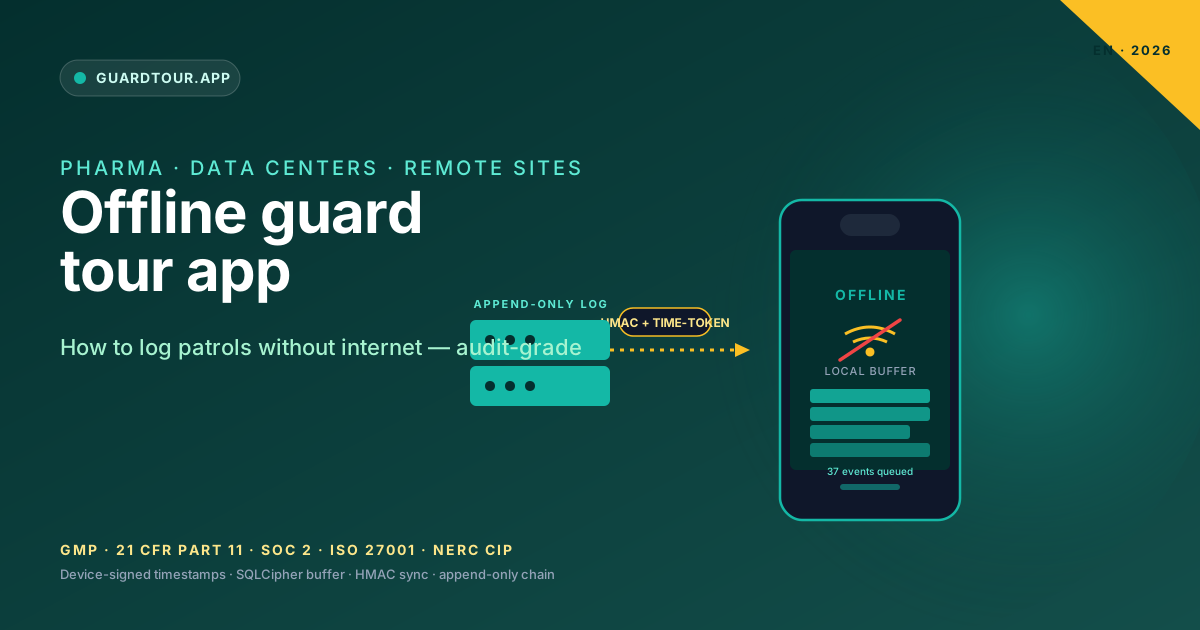
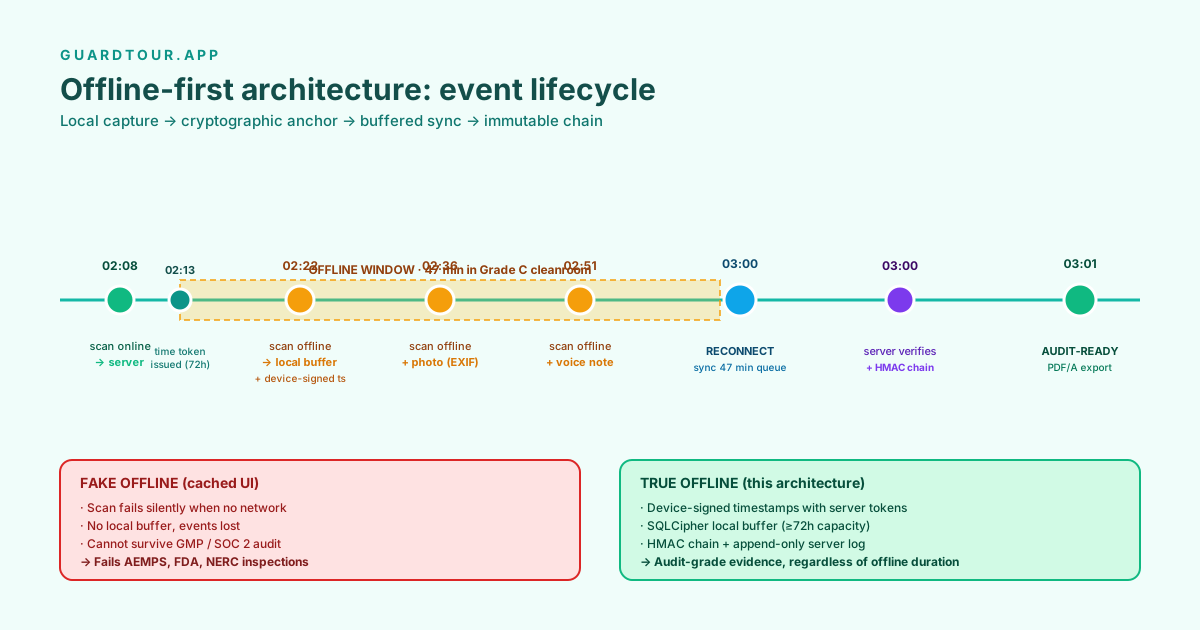
A pharma client running a Grade C cleanroom in Catalonia called us in January after a Spanish AEMPS inspector flagged their patrol log. The previous guard tour provider used a cloud-only mobile app: when guards entered the cleanroom (RF-shielded by design to prevent contamination from external electronics), the app silently dropped the connection and skipped checkpoints without alerting anyone. The audit log showed perfect compliance — except for the 47-minute gap between 02:13 and 03:00 every single night, when the on-shift guard was inside the cleanroom. The inspector noticed the pattern in 20 minutes. The factory got a Critical Observation that took 4 months and €180 000 in remediation to clear.
The lesson isn't that offline mode is useful — it's that without true offline, the entire patrol log is uncertifiable in any environment that breaks connectivity by design. Pharma cleanrooms (RF-shielded), data center cold aisles (Faraday cages), remote energy sites (no LTE), and underground utilities (no signal) all share this property. This post explains how a real offline-first guard tour app works, what evidence quality it produces, and how to spot the fake offline modes that fail audits.
What offline-first actually means
The phrase "offline mode" is one of the most overloaded terms in security software. Three distinct architectures get marketed under the same label, and only one of them survives a serious audit:
Architecture A — Cached UI ("fake offline"). The app shows a loading spinner or the last-known dashboard when the network drops. Guard tries to scan a checkpoint, the scan fails silently or shows "retrying...". When connectivity returns, no events were captured. This is what 60% of the apps marketed as "offline" actually do. Fails any GMP, SOC 2 Type II, IATF or ISO 27001 audit on first inspection.
Architecture B — Local buffer with server-trusted timestamps ("buffered online"). The app captures events locally when offline (checkpoint scans, photos, notes) and stores them in a local queue. When connectivity returns, it uploads the queue. The server stamps each event with the upload time, not the actual scan time. This breaks the legal trail because a 47-minute-old event arrives stamped as "now". Acceptable for low-stakes contexts (residential, retail), but fails pharma GMP §4.30 (data integrity) and SOC 2 CC7.1.
Architecture C — Local buffer with cryptographically anchored event time ("true offline"). The app captures events locally with a device-side timestamp signed by a server-issued time token (valid for 24-72h, rotated on each successful sync). When connectivity returns, the device uploads the buffered queue. The server validates the time tokens, accepts the device-side timestamps as canonical, and adds its own HMAC over the full event payload. Audit-grade evidence regardless of how long the device was offline. This is what GMP, SOC 2 and IATF 16949 actually require.
The difference between architectures B and C is the cryptographic anchor. Without it, the server has no way to prove the device-side timestamp wasn't manipulated by a rooted device or replayed from a different shift. With it, every offline event is as legally defensible as an online event.
Verticals that absolutely need true offline
Pharma cleanrooms (GMP Annex 1, USP <797>, ISO 14644). RF-shielded by design to prevent external contamination. Connectivity inside Grade B/C/D rooms is zero. Patrol logs are a regulatory artifact — AEMPS, FDA and EMA all inspect them. True offline is non-negotiable. The 21 CFR Part 11 requirements on electronic records (audit trail, time-stamping, immutability) extend to patrol logs in API and sterile manufacturing facilities.
Data center cold aisles (SOC 2 Type II, ISO 27001, EN 50600). Modern hot/cold aisle containment systems often act as partial Faraday cages. WiFi penetration into a sealed cold aisle is < 20% reliability. Cellular signal inside concrete-wrapped Tier III/IV data center floors is often non-existent. SOC 2 auditors specifically look for evidence quality in the patrol log — a 30-second gap because the guard walked into a cold aisle should not produce missing events.
Remote energy sites (NERC CIP, ISO 27019). Wind farms, solar fields, substations and pipeline maintenance points are often in coverage shadows. The NERC CIP-006 physical security plan requires documented patrols of Physical Security Perimeters, and the auditor reviews the patrol record for completeness. A site with 14-hour LTE blackouts cannot rely on online-only.
Underground utilities and tunnel infrastructure (EN 50122, ISO 14001). Metro stations, sewage maintenance, underground parking with multi-level B2/B3, and tunnel inspections all break cellular and WiFi predictably. Patrol logs in these environments are typically required by municipal contract and public-safety regulations.
Maritime and offshore (IMO ISPS Code, MARPOL). Patrol logs on offshore platforms, large vessels, and port facilities operating beyond standard cellular range. ISPS Code §16.3 explicitly references patrol records as required evidence; without true offline, half the shift is undocumented.
The audit evidence pipeline
A true-offline guard tour app produces evidence at five levels. Auditors look for all five — missing one compromises the others:
Level 1 — Device event capture. Each scan generates a structured event: checkpoint UUID, device GPS coordinates (with mock-location detection), device-side timestamp using a server-issued time token, NFC tag identifier, optional photo with EXIF intact, optional voice note, current shift assignment. All written to a local encrypted database (SQLCipher or equivalent) before any network attempt.
Level 2 — Cryptographic anchoring. Each event payload is hashed (SHA-256), and the hash is signed by the device-side time token (issued by the server at last sync, valid 24-72h). The signed hash is stored alongside the event. Any later modification of the event invalidates the signature — making offline events tamper-evident even before they reach the server.
Level 3 — Sync transport. When connectivity returns, the device uploads the queued events over TLS 1.3 with mTLS authentication (device certificate signed by server CA). The server validates each event's time-token signature against the issuing time, accepts device timestamps as canonical (within drift tolerance, typically ±60 seconds clock skew), and produces a server-side HMAC over the full payload using a secret rotated daily.
Level 4 — Server-side immutable storage. Events are written to an append-only log (PostgreSQL with row-level immutability, or equivalent). Each event references the previous event's hash, forming a Merkle-style chain per shift. Any retroactive modification breaks the chain and is detected by audit tools.
Level 5 — Exportable audit trail. On demand (auditor request, customer request, contractual reporting), the platform produces a signed PDF/A report with the event timeline, the cryptographic chain proof, and the device certificate trail. The auditor verifies the chain client-side using a published public key and confirms integrity without having to trust the platform vendor.
This pipeline is what differentiates "we have offline mode" from "our offline mode is audit-grade". When evaluating a guard tour vendor, ask for the spec of all five levels in writing.
Configuration recommendations by vertical
Pharma cleanroom: Local buffer capacity ≥ 4 hours of events at maximum patrol frequency (typically 200-300 events). Sync token validity = 24h, rotated on every entry/exit of cleanroom. Photo capture mandatory on every scan in Grade A/B rooms. SHA-256 + HMAC-SHA-256 for event signing. PDF/A export with 21 CFR Part 11 manifest.
Data center: Buffer capacity ≥ 8 hours. Sync token validity = 48h. NFC + GPS (with cold-aisle exception that disables GPS validation while inside known dead zones, pre-mapped during installation). Cold aisle entry/exit triggers a virtual checkpoint automatically. SOC 2 evidence pack export with CC6.6, CC7.1 and CC7.2 mappings.
Remote energy sites: Buffer capacity ≥ 24 hours (LTE blackouts of 8-14h are common). Sync token validity = 72h. Mandatory satellite-fallback option for SOS / dead-man alerts. Battery-aware sync (defers sync if device < 20%, prioritizes life-critical events). NERC CIP-006 reporting template.
Underground/tunnel: Buffer capacity ≥ 4h. Sync token validity = 48h. WiFi pre-mapped at known entry points; automatic sync attempt every 60 seconds during transit through mapped WiFi zones. Lone-worker dead-man check-in mandatory in underground environments per EN 16753 best practices.
Maritime/offshore: Buffer capacity ≥ 48 hours. Sync token validity = 72h. Optional Iridium satellite gateway for low-bandwidth critical event upload. ISPS-compatible export with PSO sign-off field.
Common failure modes when offline isn't done right
Silent event drops. App tries to upload, fails, then discards the event without writing to local buffer. The guard sees a "scan failed" toast and tries again — but the original scan never made it into the audit log. This is the most common failure in retrofitted online-only apps.
Timestamp drift exploits. A guard with a rooted device modifies the local clock during offline operation. Without a server-issued time token, the modified timestamps survive the eventual sync. The auditor finds events stamped 03:00 that the cameras show happened at 04:30.
Buffer corruption on app crash. Local buffer in a plain SQLite database with no integrity protection. App crashes mid-shift, buffer corrupts, evidence lost. Production-grade implementations use SQLCipher with WAL mode and crash-recovery testing.
No proof of offline duration. When the audit asks "how long was the device offline?", the app can't answer because it didn't record connectivity transitions. Audit-grade apps log every connectivity state change as an event in itself.
Mock-location bypass. Guard installs a GPS spoofing app on a rooted device, generates fake positions while sitting at home. Without device integrity checks and mock-location detection, the offline buffer fills with plausible but fabricated events that pass the eventual sync.
How guardtour.app implements true offline
guardtour.app is built around the architecture C model: device-side timestamps with server-issued time tokens, SQLCipher local buffer with capacity for 72+ hours of operation, SHA-256 + HMAC event chaining, mTLS sync transport, append-only PostgreSQL storage with row-level immutability, signed PDF/A audit exports with public-key verification. Cleanroom mode, cold-aisle mode and remote-site mode are pre-configured profiles that adjust buffer size, sync token validity, and GPS-validation behavior. Mock-location and root detection are enforced at app launch with shift-level alerts to supervisors. Iridium satellite gateway available for offshore deployments via partner integration.
To go deeper
- /blog/nfc-token-for-guard-tour-software — how the NFC tag itself contributes to the cryptographic chain.
- /blog/hot-cold-aisle-patrol-soc2-evidence — specific SOC 2 mapping for data center patrols.
- /blog/eu-ai-act-guard-tour-software-2026 — how the EU AI Act treats the patrol log as evidence of decision-making.
- /blog/what-is-guard-tour-software — the fundamentals of guard tour software and where of